








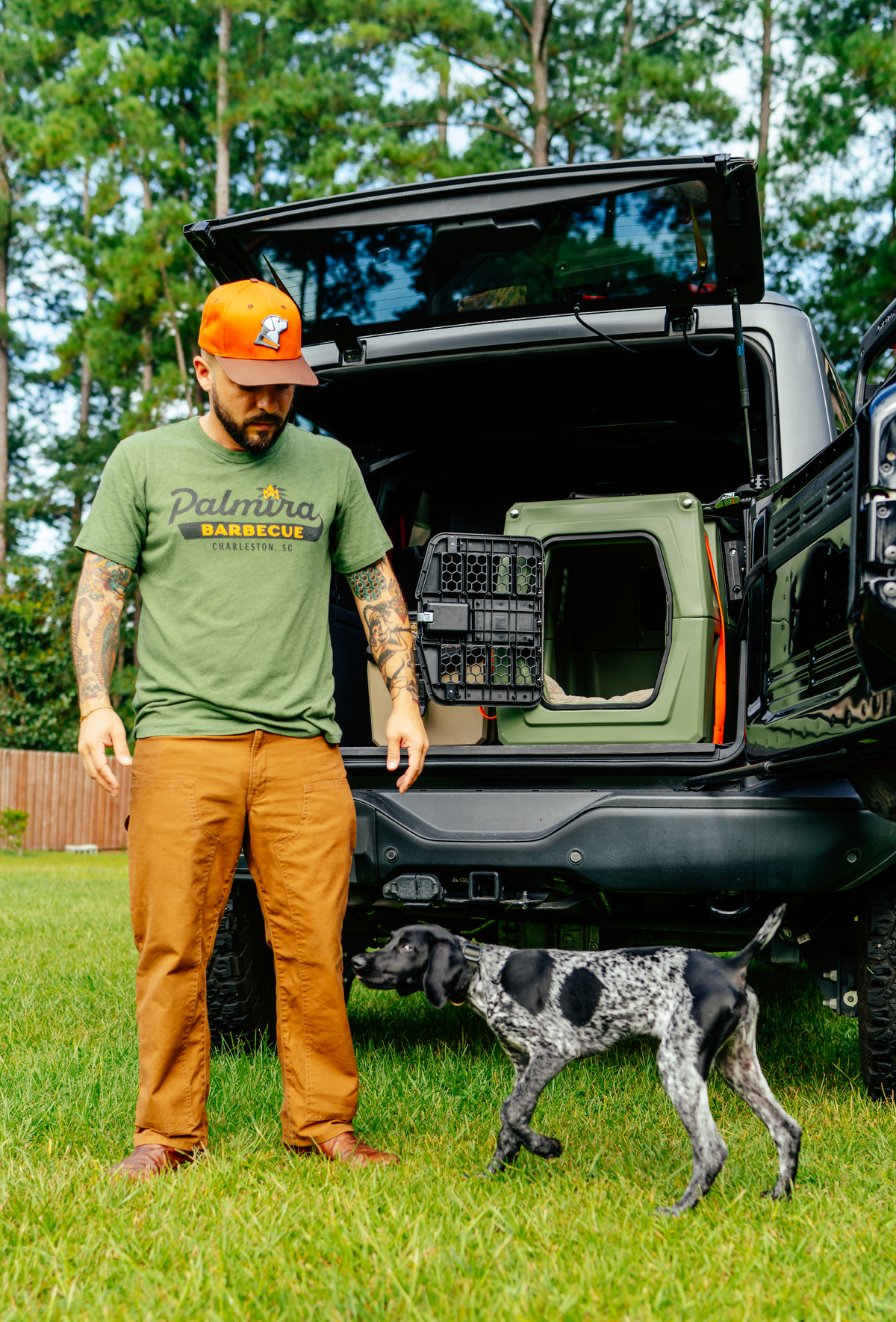
A Q&A with Hector Garate of Palmira Barbecue in Charleston, SC.
Take us back to the beginning: what are your earliest memories of hunting, and who were you with?
Some of my earliest memories of hunting are really about being around family and being outside. It wasn’t just about going out and killing something. It was the whole experience — getting up early, being together, learning from the older generation, and then coming back and sharing a meal.
Growing up Puerto Rican, food and family were always connected, so even when we were outdoors, there was always this idea that what you harvested had a purpose. You respected it, you cooked it, and you shared it.

What did hunting look like in your family growing up, and what did they teach you about it beyond the hunt itself?
The biggest thing was respect. Respect for the animal, respect for the land, and respect for the people teaching you.
There’s also patience involved. You can’t control everything when you’re hunting. You have to slow down, pay attention, and appreciate where you are. Those are things I probably didn’t fully understand when I was younger, but now I do.
Were dogs part of those early memories? Was there a particular dog, hunting dog or otherwise, that shaped your idea of what a great dog should be?
Dogs were always something I loved, but I didn’t grow up with the kind of relationship I’m building now with Frida.
What I always believed made a great dog was loyalty and that connection with the family. Now with Frida, I’m learning there’s another level to it. Watching a dog work, seeing their instincts come alive, and knowing that you’re developing that together is pretty special.
You eventually fell away from hunting for a while. What pulled you away from it, and what made you start thinking about coming back?
Life happened. I got focused on work, building my career, opening Palmira, raising a family — all those things start taking up your time.
But the outdoors never really leaves you. Eventually I started feeling like I wanted that part of my life back. I wanted something that forced me to slow down and get away from everything else.
Why did this season of life, feel like the right time to return to it?
My son was probably the biggest reason.
Once you have kids, you start thinking differently about time. You realize you only get so many seasons with them at each age. I wanted us to have something we could learn together and hopefully something he carries with him long after I’m gone.
I don’t need him to become obsessed with hunting. I just want him to remember being out there with his dad.
Was getting a bird dog always part of that vision? Why a GSP, and how did Frida ultimately become your dog?
Once I really started getting interested in bird hunting again, I knew I wanted a dog to be part of it.
I kept coming back to German Shorthaired Pointers because they’re incredible athletes, they’re smart, they have that natural drive in the field, but they can also become part of the family.
Then Frida came along. I went all the way to Omaha to get her, and pretty quickly she became more than just “the hunting dog.” She’s part of the family now.

Tell us about Frida. What’s her personality like right now, and what have you learned about her since bringing her home?
Frida is full of personality. She’s energetic, curious, stubborn sometimes, extremely smart, and she wants to be involved in everything.
She’s still young, so right now I’m watching her figure out the world. But you can already see that hunting instinct in her. When that switch turns on and she starts using her nose, it’s incredible.
She’s also taught me patience. You can’t rush a dog. You have to understand what they’re telling you and build that trust.
When you picture Frida three or four years from now, what kind of dog do you hope she becomes, both in the field and as part of your family?
I want her to be a really solid bird dog — confident, steady, able to work wild birds and understand what we’re asking of her.
But just as important, I want her to be the dog my kids remember growing up with.
I want her riding with us, hunting with us, hanging around the house, coming on trips — being part of our life. If she becomes an incredible hunting dog and an incredible family dog, that’s the dream.
How are you approaching her training, especially as someone who’s also finding his own way back into bird hunting? Does it feel like the two of you are learning together?
Absolutely.
That’s actually one of my favorite parts of this whole thing. I’m not pretending I know everything. I’m learning again, and Frida is learning at the same time.
I’m trying to surround myself with people who know more than I do, ask questions, train consistently, and not rush the process.
I think that’s what makes it meaningful. Hopefully three or four years from now I can look back and remember when neither one of us really knew what we were doing.
Is there one milestone you’re especially looking forward to?
Her first real wild-bird point and watching my son experience it with me.
There will be plenty of milestones, but I think that first moment when everything comes together — Frida locks up, the bird gets up, and my son is standing there seeing what she was bred to do — that’s going to stay with me.
What do you hope your son learns from hunting alongside you and watching you raise and train Frida?
Patience, responsibility, and respect.
I want him to understand that hunting isn’t just about pulling a trigger. There’s preparation, conservation, taking care of your equipment, taking care of your dog, respecting the animal, and using what you harvest.
And I want him to understand that the experience matters more than the result.
Some days we might walk miles and never shoot anything. If we spent that day outside together with Frida and came home with a good story, that’s still a great day.
You’ve built your career around barbecue and cooking over fire. Hunting and barbecue both have deep traditions of gathering people and passing knowledge from one generation to another. Where do those two worlds intersect for you?
For me, they’re almost the same language.
Barbecue is about patience, fire, instinct, tradition and gathering people around food. Hunting has a lot of those same things.
Neither one should be rushed.
And there’s something powerful about knowing exactly where your food came from. If my son and I spend a morning in the field with Frida, harvest a few birds, bring them home, cook them over a fire, and sit around a table together — that’s the entire circle.
That’s bigger than barbecue and bigger than hunting.
That’s tradition.
Imagine a few hunting seasons from now, what’s happening next?
I picture my son being a little older, Frida being completely dialed in, and us planning our year around different hunts.
Maybe we’re chasing bobwhite in the South, woodcock back home, or taking a trip somewhere out West.
Then we come back to wherever we’re staying, light a fire, cook what we harvested, and sit around telling stories about the day.
That’s really what I want.
I want Frida to become part of our family’s story. And years from now, when my son thinks about hunting, I hope he doesn’t just remember the birds.
I hope he remembers his dad, Frida, the fire, the food, and the time we spent together.